Category: Religion

  • The Seven Churches of Asia Minor: A Journey Through Early Christian History

    The Seven Churches of Asia Minor: A Journey Through Early Christian History

    Scattered across the landscape of western Turkey lie the ruins of seven ancient cities that played a pivotal role in the birth of Christianity. Known as the Seven Churches of Asia—or the Seven Churches of the Apocalypse—these locations were the recipients of the letters recorded in the Book of Revelation, written by the Apostle John near the end of the first century .

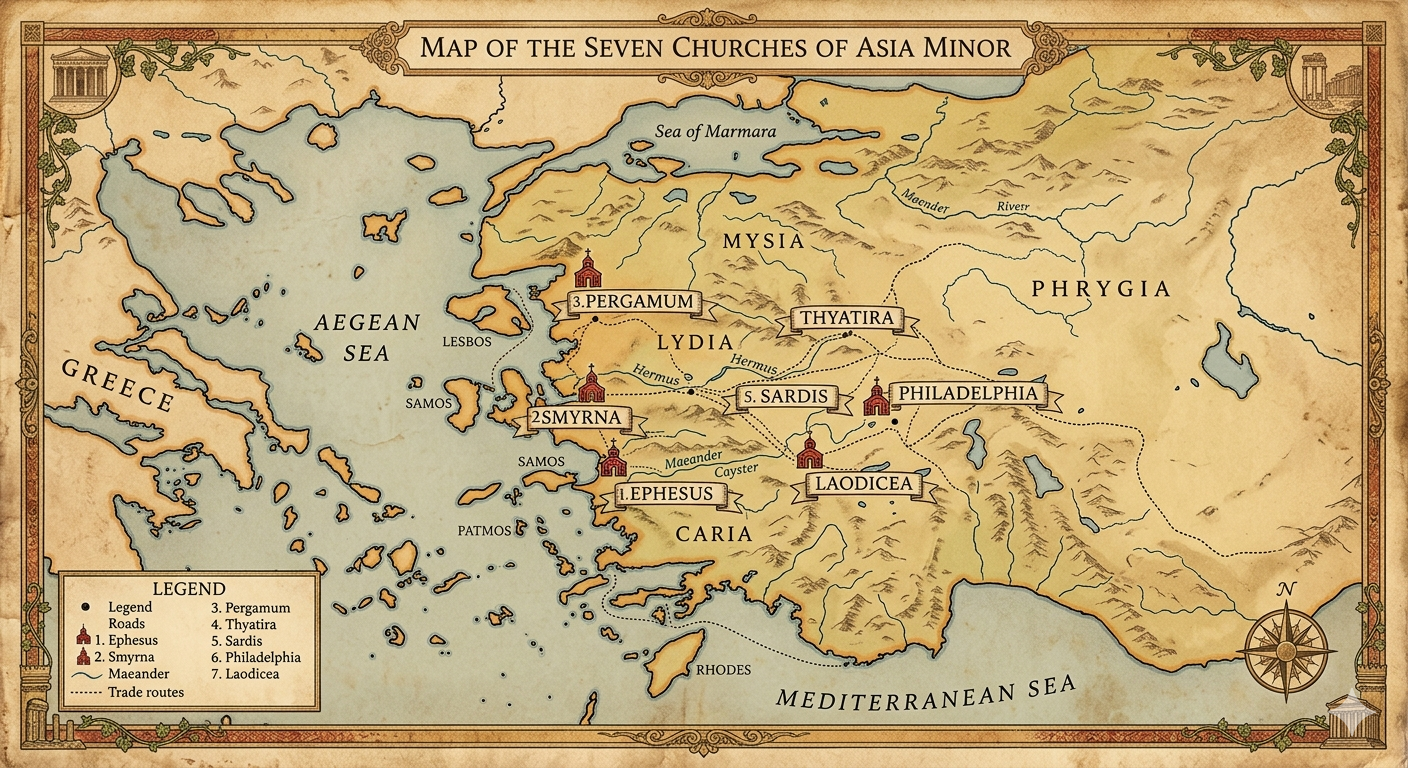
    At a time when Christians faced growing persecution under Roman rule, Jesus instructed John on the island of Patmos to “write in a book what you see, and send it to the seven churches, to Ephesus, to Smyrna, to Pergamum, to Thyatira, to Sardis, to Philadelphia, and to Laodicea” (Revelation 1:11) . These letters contained both praise and rebuke, offering timeless lessons for believers throughout history.

    Today, these ancient sites continue to captivate pilgrims, archaeologists, and historians. Each city tells a unique story—of faith tested, of warnings ignored, and of promises given to those who persevere.


    The Historical Context: Asia Minor in the First Century

    The Roman province of Asia encompassed most of western Asia Minor, including the regions of Caria, Lydia, Phrygia, and Mysia . This was the wealthiest region of the entire Roman Empire, and its cities were centers of commerce, culture, and pagan worship. By the time John wrote Revelation (approximately 90-100 AD), the province had been under Roman rule for more than two hundred years .

    The political and religious climate was particularly challenging for early Christians. The imperial cult—worship of the Roman emperors as gods—was deeply entrenched throughout Asia. Augustus was hailed as “saviour of mankind” and worshipped as a “present deity” . Christians who refused to participate in such worship faced suspicion, persecution, and even martyrdom.

    The seven churches were not chosen at random. They lay along a major Roman postal route, forming a rough circle, and represented communities that John either knew personally or had received reports about . Their struggles—with persecution, false teaching, complacency, and loss of spiritual passion—reflect challenges that have confronted believers in every era.


    1. Ephesus: The Church That Lost Its First Love

    The City

    Ephesus was the most prominent city in the province of Asia, serving as its commercial and political center. The city was famous for the Temple of Artemis, one of the Seven Wonders of the Ancient World. Paul had ministered in Ephesus for over two years, and Timothy later served as an elder there . The church in Ephesus was likely the recipient of as many as eight New Testament books: the Gospel of John, Ephesians, 1 and 2 Timothy, 1, 2, and 3 John, and Revelation .

    The Message (Revelation 2:1-7)

    The letter to Ephesus begins with high praise. Christ commends the church for its hard work, perseverance, and refusal to tolerate evil men. The Ephesians are noted for testing those who claim to be apostles and finding them false, and for enduring hardship for Christ’s name without growing weary .

    Yet despite these commendable qualities, a serious problem exists: “You have forsaken the love you had at first” (Revelation 2:4). The church had become orthodox in doctrine and diligent in service, but somewhere along the way, its heart had grown cold.

    The Warning and Promise

    Christ calls the Ephesians to remember their former passion, repent, and return to their first works. The warning is stark: if they do not repent, their lampstand—representing their church’s witness—will be removed . To those who overcome, Christ promises access to the tree of life in the paradise of God.

    Modern Significance

    Ephesus speaks to every church that has prioritized correct theology and busy activity over genuine love for Christ. It is possible to do all the right things for all the wrong reasons—or with a heart that has lost its passion.


    2. Smyrna: The Suffering Church

    The City

    Smyrna (modern Izmir) was a beautiful, wealthy port city known for its loyalty to Rome. It was a center of the imperial cult, with a temple dedicated to the goddess Rome and later to Emperor Tiberius. Christians in Smyrna faced intense pressure to participate in emperor worship, and refusal brought severe consequences.

    The Message (Revelation 2:8-11)

    The letter to Smyrna contains no rebuke—only encouragement. Christ acknowledges their affliction and poverty, yet declares, “You are rich” (Revelation 2:9). He also warns of coming persecution: the devil will put some of them in prison to be tested, and they will suffer for ten days .

    The message is simple: “Be faithful, even to the point of death, and I will give you life as your victor’s crown” (Revelation 2:10).

    The Promise

    To the one who overcomes, Christ promises that they will not be hurt by the second death—the eternal separation from God that awaits the unrighteous.

    Modern Significance

    Smyrna represents believers who suffer for their faith. The promise is not deliverance from suffering but preservation through it. The crown of life is given not to those who avoid hardship but to those who remain faithful when hardship comes.


    3. Pergamum: Where Satan’s Throne Stands

    The City

    Pergamum (modern Bergama) was the provincial capital of Asia and a major center of pagan worship. It boasted massive altars to Zeus, Athena, and Dionysus, as well as a temple dedicated to the divine emperor Augustus. The city’s great altar to Zeus is likely what Revelation refers to as “Satan’s throne” (Revelation 2:13) . It was also the first city in Asia to build a temple to a living emperor (Augustus in 29 BC), making it a bastion of the imperial cult.

    The Message (Revelation 2:12-17)

    The church in Pergamum is commended for holding fast to Christ’s name even while living in a city dominated by satanic opposition. Specifically, they remained faithful even when one of their own—Antipas—was martyred .

    However, Christ has a few things against them. Some in the church hold to the teaching of Balaam, which led Israel into idolatry and sexual immorality. Others follow the Nicolaitans, a group whose teachings promoted compromise with pagan society .

    The Warning and Promise

    Christ calls the Pergamenes to repentance. To those who overcome, He promises hidden manna—a reference to God’s provision in the wilderness—and a white stone with a new name written on it . White stones were used in ancient times as tickets of admission to banquets or as tokens of acquittal in courts.

    Modern Significance

    Pergamum represents churches that try to live faithfully in overwhelmingly hostile environments. The warning is against compromise—adopting the world’s values while claiming to follow Christ.


    4. Thyatira: The Tolerant Church

    The City

    Thyatira (modern Akhisar) was a smaller city than the others, known for its trade guilds. These guilds were closely linked to pagan worship, and Christians who refused to participate often faced economic hardship. Lydia, the seller of purple cloth converted by Paul in Acts 16, was from Thyatira.

    The Message (Revelation 2:18-29)

    The letter to Thyatira is the longest, addressed to a church with much to commend it. Christ praises their love, faith, service, and perseverance—noting that their “latter works are greater than the former” .

    But the praise is followed by sharp rebuke: the church tolerates a woman referred to as “Jezebel,” who calls herself a prophetess and leads believers into sexual immorality and idolatry . This tolerance of false teaching has corrupted the church from within.

    The Warning and Promise

    Christ has given Jezebel time to repent, but she has refused. Judgment will come upon her and her followers. But to those who have not followed her teaching—who “hold fast” until Christ comes—He promises authority over the nations and the morning star .

    Modern Significance

    Thyatira represents churches that are loving and active but dangerously tolerant of false teaching. The message is clear: love must be balanced with discernment, and tolerance of evil is not a virtue.


    5. Sardis: The Dead Church

    The City

    Sardis was an ancient capital of the Lydian kingdom, famous for its wealth and military might. The city was built on a seemingly impregnable acropolis, yet it had been captured twice because its defenders grew complacent. This history of unexpected defeat provides the background for Christ’s warning to the church .

    Archaeological excavations at Sardis have uncovered several Byzantine-era churches, including Church EA—a fourth-century basilica built on the grounds of the abandoned Temple of Artemis. The careful craftsmanship of this church suggests that by the mid-fourth century, the Christian community had reached a point of prominence in Sardis .

    The Message (Revelation 3:1-6)

    The letter to Sardis contains no praise—only rebuke. The church has a reputation for being alive, but Christ declares it is dead. Their works are “incomplete” in God’s sight .

    The call is urgent: “Wake up! Strengthen what remains and is about to die” (Revelation 3:2). They must remember what they have received and heard, hold fast, and repent.

    The Promise

    Yet even in this dead church, there are a few who have not “soiled their garments.” They will walk with Christ in white, for they are worthy. To the overcomer, Christ promises that their name will never be blotted out from the book of life .

    Modern Significance

    Sardis represents churches that look alive on the outside—busy, respected, active—but are spiritually dead. The warning is against reputation management over real spiritual vitality.


    6. Philadelphia: The Faithful Church

    The City

    Philadelphia (modern Alaşehir, named since 1390) was founded as a center for spreading Greek culture and language in the region of Lydia and Phrygia. It was known as the “city of earthquakes”—frequent seismic activity forced residents to live outside the city walls much of the time. This vulnerability may explain the promise of stability in the letter .

    The Message (Revelation 3:7-13)

    Like Smyrna, Philadelphia receives no rebuke. Christ commends the church for keeping His word and not denying His name, even though they have “little strength” .

    Christ sets before them “an open door that no one can shut.” This likely refers both to opportunities for mission and to the promise of future access to God’s kingdom. The church is promised protection from “the hour of trial” that will come upon the whole world .

    The Promise

    The overcomer will be made a pillar in the temple of God—a symbol of permanence and stability in a city known for earthquakes. God’s name, the name of the New Jerusalem, and Christ’s new name will be written on them .

    Modern Significance

    Philadelphia represents faithful believers who may lack power, influence, or numbers but remain steadfast. The promise is that God sees their faithfulness and will reward it with eternal security and honor.


    7. Laodicea: The Lukewarm Church

    The City

    Laodicea (near modern Denizli) was a wealthy banking and commercial center, known for its black wool industry and a medical school that produced an eye salve. The city’s water supply came by aqueduct from hot springs; by the time it reached Laodicea, it was lukewarm and unappealing—a perfect metaphor for the church’s spiritual condition .

    Recent archaeological discoveries continue to illuminate Laodicea’s significance. In 2025, researchers unearthed the remains of a massive Roman council hall dating back approximately 2,050 years. Within the ruins, they found a cross carved into stone and the early Christian Chi-Rho monogram (representing the first two letters of “Christ” in Greek), alongside Greek text . These etchings suggest that between the second and fourth centuries, Christians were a growing presence in the city despite facing persecution .

    The Message (Revelation 3:14-22)

    The letter to Laodicea contains some of the most sobering words in all of Scripture. The church is neither cold nor hot, but lukewarm—and because of this, Christ declares He will “spit you out of my mouth” .

    The Laodiceans boast, “I am rich; I have acquired wealth and do not need a thing.” But Christ sees their true condition: wretched, pitiful, poor, blind, and naked . Their self-sufficiency is their greatest spiritual danger.

    The Warning and Promise

    Christ counsels them to buy from Him gold refined by fire (true spiritual riches), white garments to cover their shameful nakedness (righteousness), and salmone to anoint their eyes so they can see (spiritual discernment) . These images directly counter the city’s famous banking, textile, and medical industries.

    The letter ends with a tender invitation: “Behold, I stand at the door and knock. If anyone hears my voice and opens the door, I will come in to him and eat with him, and he with me” (Revelation 3:20). To the one who overcomes, Christ promises the right to sit with Him on His throne.

    Modern Significance

    Laodicea represents the danger of material prosperity leading to spiritual complacency. The church that feels self-sufficient—that believes it needs nothing—is often the neediest of all.


    The Pattern of the Letters

    Each of the seven letters follows a similar structure :

    1. Address: “To the angel of the church in [city] write”
    2. Self-identification of Christ: Drawn from the vision in Revelation 1
    3. Commendation: Praise for what the church is doing well
    4. Rebuke: Correction for where the church has failed
    5. Warning: “Repent, or else…”
    6. Exhortation: “He who has an ear, let him hear what the Spirit says to the churches”
    7. Promise: A reward for those who overcome

    This consistent pattern emphasizes that these messages, while written to specific first-century communities, carry timeless lessons for all believers.


    The Legacy of the Seven Churches

    Archaeological Significance

    The seven churches have been the focus of archaeological investigation for over a century. In 1869, Alexander Svoboda published The Seven Churches of Asia, featuring the first photographs ever taken of these sites . Excavations continue to this day, with recent discoveries at Laodicea demonstrating the enduring archaeological importance of these locations .

    Theological Significance

    For centuries, theologians have debated whether the seven churches represent only historical communities or also serve as prophetic previews of church history. Some scholars—particularly within dispensationalist traditions—interpret the seven churches as representing seven different periods in the history of the Western church . Others caution against overly rigid historical schematization, noting that the struggles addressed—loss of love, persecution, compromise, dead orthodoxy, faithfulness, and complacency—have recurred in every generation .

    Pilgrimage Today

    Today, the ruins of the seven churches are popular destinations for Christian pilgrims and history enthusiasts. Visitors can walk the streets where Paul and John once walked, stand in the theaters where early Christians faced hostile crowds, and see the remnants of temples where the imperial cult once demanded worship. Modern cities have grown up around some sites—Izmir (Smyrna) and Alaşehir (Philadelphia) are living cities—while others, like Ephesus and Sardis, remain largely archaeological sites.


    Conclusion

    The seven churches of Asia Minor received letters that were personal, urgent, and prophetic. Each church faced unique challenges, yet all received the same call: to hear what the Spirit was saying and to overcome.

    These messages have transcended their original historical context to speak to believers across the centuries. The church that loses its first love, the church that suffers for its faith, the church that compromises with the world, the church that tolerates false teaching, the church that is dead while appearing alive, the church that remains faithful despite weakness, and the church that is lukewarm in its complacency—these are not merely first-century problems. They are the perennial challenges of the people of God.

    The promise to each church is the same: to the one who overcomes, Christ offers eternal rewards—the tree of life, the crown of life, hidden manna, authority over the nations, white garments, a place as a pillar in God’s temple, and a seat on Christ’s throne.

    The question that echoes through the centuries is the one each letter ends with: “He who has an ear, let him hear what the Spirit says to the churches.”


    References

    • Wikipedia contributors, “Seven churches of Asia,” Wikipedia 
    • Wikipedia contributors, “Byzantine churches at Sardis,” Wikipedia 
    • W.M. Ramsay, Letters to the Seven Churches of Asia, Christian Classics Ethereal Library 
    • Bible Hub, “The Seven Churches of Asia Minor,” Topical Encyclopedia 
    • A. Margolis, “2,000-year-old Roman hall remains unearthed in biblical city linked to early Christian worship,” New York Post, 2025 
    • “Mysterious Christian symbols unearthed in biblical city reveal secrets of the Book of Revelation,” Daily Mail, 2025